
Teaching your Children About Taxes
- Jan 30
- 11 min read

“In this world nothing can be said to be certain, except death and taxes.”
“I like to pay taxes. With them I buy civilization.”
“No taxation without representation!”
“The avoidance of taxes is the only intellectual pursuit that still carries any reward.”
“That the power to tax involves the power to destroy…”
“The hardest thing in the world to understand is the income tax.”
"Every tax ought to be levied at the time, or in the manner, in which it is most likely to be convenient for the contributor to pay it.”
“For a nation to try to tax itself into prosperity is like a man standing in a bucket and trying to lift himself up by the handle.”
“The politician’s promises of yesterday are the taxes of today.”
Note: this article may only be appropriate for teenagers. Use your best judgement.
We’ve shared above a sampling of memorable quotes from well-known voices—Benjamin Franklin, Winston Churchill, Adam Smith, and others. But handling your taxes cannot be summarized in a small collection of clever lines; paying your taxes is a major life skill that your children (and plenty of adults) need to understand. And as your children grow to become teenagers and later as young adults, they need to learn what happens to the money in their paycheck, how withholding works, how to plan and budget around taxes, what can happen if taxes aren’t paid, and how to be responsible citizens when voting on proposals and candidates who promise new spending. They also need to recognize the real-world tradeoffs: government programs are funded by the monies collected from individuals and families in the form of taxation, and it’s wise to be discerning about how that money is used and whether our leaders in governmetn will steward it wisely. At the same time, as Christians, we must hold another truth just as firmly: paying taxes is not optional for believers—it’s part of our obedience to God. Jesus said, “Render to Caesar what is Caesar’s, and to God what is God’s” (Matthew 22:15–22). Of course, this statement raises important questions worth exploring: what legitimate responsibilities belong to civil government, and what ultimate allegiances belong to God? That is to say, what belongs to Caeser (government) and what belongs to God, as Jesus describes?
In this article, we will discuss how to equip your children with the right mindset about taxes: what is right to do, how to treat them, and what not to do. So let's get into it!

The New Testament explicitly includes the payment of taxes as a necessary act of submission to the lawful authority of government, which was instituted by God.
Paul tells us that governing authorities are “instituted by God” to maintain order, and he specifically names taxes as something Christians should pay (Romans 13:1–7). Peter similarly urges Christians to submit to human authorities and to honor them (1 Peter 2:13–17). And even Jesus describes the importance of paying taxes, “Render to Caesar what is Caesar’s, and to God what is God’s” (Matthew 22:15–22; also Mark 12, Luke 20). Paying taxes is also tied to Christian ethics: honesty and witnessing. How can you can be a valid witness to others, living as a symbol of authenticity and honesty when you are cheating on your taxes? Christians are called to be truthful, avoid fraud, and “owe no one anything” in the sense of meeting legitimate obligations (Romans 13:7–8) in our world. Practically speaking, this means paying what’s due and what is necessary for a governed society to operate, not cheating the system (even if its possible to do so without being caught), and to be honest in all things.
It doesn’t mean endorsing everything the government does.
There’s a limit: obedience to God comes first.
As described in the Bible, God’s people often criticize rulers and unjust systems -- and even today we are justified in the same criticisms towards modern governments. The paying of taxes is meant to fulfill a civic obligation, but paying your taxes is not a moral approval of every policy funded by those taxes. Further, not all taxes are morally founded. When taxes become a tool by which dictators and tyrants enforce their immoral and unlawful edicts -- not by the consent of the governed -- but through the threat of government force, they are establishing themselves above God, and we have no moral obligation to support them given such circumstances. In fact, we may be morally obligated -- as Chrisitans -- to oppose them.
In other words: God comes first and there are limitations to the authority yield by the state
Children must learn that the government is not God.
Christians must respect laws, but their highest loyalty is to God. Communicating this message to your children will help them build a healthy view of authority: respect of government without worship, and always to have the courage to do what is right. More to point, government is not our God. Governments are instituted by fallible human beings and run by fallible human beings, and they do make mistakes regularly. Often times these mistakes are compounded into errors when the system of government doesn't work right. And then these errors can become tyranny when the actors of the system (politicians, bureaucrats, etc.) decide that they can yield their power to do what they want, instead of obeying the law.
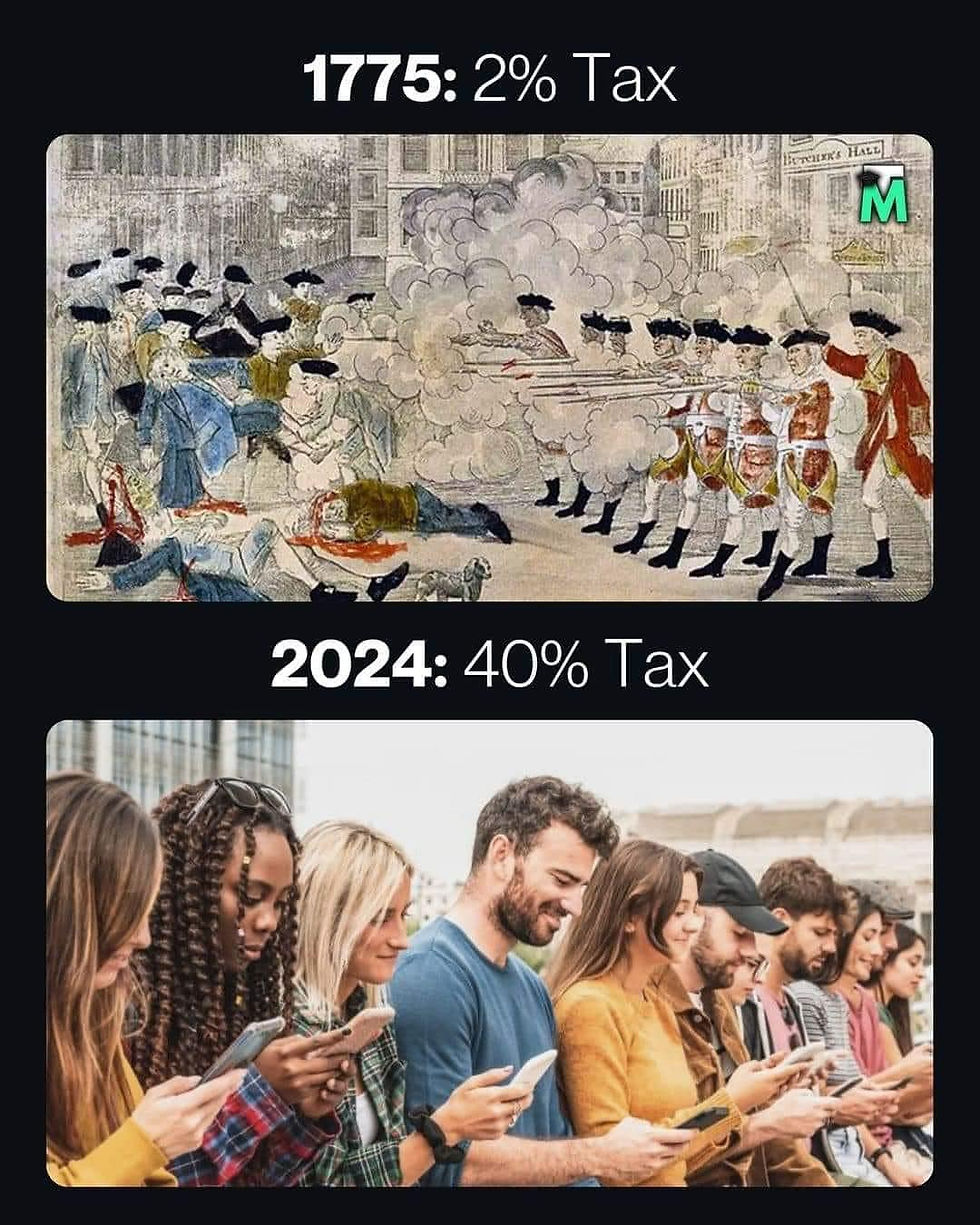
The primary cause of the American Revolution: a government that had set itself above Godly authority, and was using taxes as a means to commit evil.
The situation described above is exactly what occurred before the American Revolutionary War. In the mid 1700s Colonial Americans were being unfairly taxed out of their homes, livelihoods and properties to support the endless immoral wars of the British government in pursuing and maintaining a global imperial colonial empire that was rooted in the suppression of freedoms and liberties, and they could stand for it no longer. The British King had effectively made himself God, setting aside any morally grounded limitations of his power and he had empowered his agents and officers to bring harm and destruction upon the Colonials: to tax them to death. And King George had established the Star Chamber, where he would drag you into his court and issue a ruling of your guilt based entirely upon his feelings about you, as well as through other mechanisms. He also incorporated this same system across his colonies in the Americas, empowering thousands of tax agents to take whatever they wanted, whenever they wanted, from Americans. And this roused the people of the America to rise up against King George's illegitimate acts, well described in our Declaration Independence.
But contrary to what many Americans are taught in the public school system, the American Revolution did not begin with a bunch of rich landowners deciding one day that the British government and King George were being unfair to them: the American Revolution began in churches across the colonies, with pastors, ministers, deacons, and priests seeing their flocks of believers becoming destitute from the acts of an illegitimate tyranny, realizing that the British government had become a moral evil, and that something had to be done. They spoke out against King George and his government in church, from the pulpit. And what did the king do in response? He escalated his tyranny, imprisoning anyone who disagreed with him -- without judges, trials, or juries, for which the colonists were entitled to under longstanding British law (the Magna Carta and proceeding laws) and enacted even more taxes, all without the consent of the colonial governments. It wasn't the taxes themselves that caused the revolution (although these were bad and added fuel to the fire)-- it was the illegitimacy of the government's acts and the harsh method of their application that was employed. The revolutionary war slogan of "No taxation without representation", did not mean "no taxes at all": it meant they wouldn't be taxed without the consent of the governed.
So how should we understand modern taxes today? What should we teach our children about them?
We should pay our taxes but pay the absolute minimum that is legally required.
Pay your taxes according to what the law says, but pay only absolute minimum. Some people may try to describe the act of paying lower taxes as using "tax loopholes", implying that when millionaires and billionaires find ways to avoid paying a high tax rate is something immoral: this is not the case. You are required to pay your taxes but only the absolute minimum that is required as determined by the law. So the saying goes: "All law is technicality", and if you can find a lawful way (emphasis on lawful) to avoid paying as high of taxes as you would otherwise -- do it! You are in no way morally obligated to pay more than you should.
Why? The tax system (at least, in the United States) is partially rigged by thieves: we call them politicians, but most of them are thieves (there are a few honest ones mixed in too). By paying more to the bureaucrats managing the taxes collected than you should, you're only enabling the government to enage in more thievery. To put it this way, the best person to decide for who and what your money should be spent on -- is you -- not some faceless bureaucrat that operates within a sea of subjective and often contradictory regulations that you never agreed to or voted on. And you should be free to give your money and spend it on causes you feel are just: tithing in church, donating to worthy causes, etc. rather having some bureaucrat make such decisions for you.
What if you only paid for fire, police, and road maintenance in your property taxes and everything else had a crowd funding page? Americans would have vastly more financial freedom. And it seems everyday like there are more ballot initiatives to increase taxes during every election cycle. Voters will usually say "yes" to these initiatives because they all sound good, completely ignoring the economic challenges that these spending bills impose upon everyone. And although any specific spending bill may seem like a small amount, they have terrible long-term consequences.


But if the system is rigged by thieves, then why should we pay our taxes?
First and foremost, you will go to prison if you don't: this is something that your children must know. If you don't pay your taxes you will be found out and eventually prosecuted, or at least you will have your paycheck confiscated from you, through wage garnishment.
But beyond this practicality, some portion of our taxes is used for moral purposes. For example, our taxes provide for a common defense of the United States from foreign countries and this is a completely legitimate and justified purpose for the collection of taxes. And a portion of the taxes collected are used for managing trade with foreign nations: again, these functions of government are legitimate and must be supported. Moreover, always remember that as Christians, our true treasure is in heaven, not in the little pieces of paper or digital bits stored on some network servers somewhere. More to the point, this temporal treasure (money) can be easily taken away from you, even when your savings and investments are completely secure. (Suggested reading: see The Creature from Jekyl Island to know about how the Federal Reserve taxes you without ever collecting taxes from you).
"All Law is Technicality" (the laws of government)
The laws of government (not to be confused with Christian law) are only those that have been passed under the consent of the governed, which are written down on publicly available documents that anyone may read and understand: they are not necessarily the secret policies or procedures that bureaucrats follow on a daily basis. Moreover, these laws have specific meaning in their words: no more and no less. For example, a law against jaywalking might state, "A person is guilty of jaywalking if they walk across a highway at a location without a crosswalk and impede the flow of traffic." The technicalities of such a law in whether a person has jaywalked would require that: 1) they were crossing a highway (not any type of street), 2) they have crossed at a location without a crosswalk, and 3) have impeded the flow of traffic. If they crossed when no one was driving through or on a normal street or at a crosswalk, according to this law (as it is written), it would not be jaywalking. What this mean generally is that:
Bureaucrats (a.k.a. the people who news reporters often call "regulators") cannot create laws. When they create regulations, they do not have to be obeyed unless there is an actual law that empowers those regulations that the bureaucrat has authored to be enforced.
Laws are only in terms of what was actually written. The subjective opinions or policies of bureaucrats are not law, unless there is an actual written law that allows such.
While this is a fairly deep subject, all law in the United States is rooted in the Constitution. If an officer or agent of the government is operating contrary to what is stated in the Constitution and is not operating according to statute (laws), they are probably acting outside of their lawful authority.
This directly applies to the payment of taxes: how much, how often, when, and how they are to paid, and for what reasons must only be based upon what the law says. For example, an IRS agent may be empowered to audit your tax returns (which is a function of tax law) but he is not empowered to create extra-legal rules (outside the law) during such an audit, such as to demand to go into your house to check your financial documents or demand you provide your business contracts. Although such policies may make his work easier -- they are not the law -- and you are not obligated to follow them, unless the actual law says so.
Note: concerning homeschooling, this means that the extra-legal policies your school district may have created usually do not have the force of law, even if school administrators may believe so. And if they try to enforce these policies you are right in resisting them, because they are not laws. For more information on this subject, consult the Homeschool Legal Defense Foundation.
Aim to live in a low-tax state
Politicians in high tax states like California and New York have become drunk on their taxpayers monies, which they use these monies for their own lavish programs that benefit themselves and their constituents. And although the taxpayers of these states may be surviving paycheck to paycheck, and live in a relative state of comfort and accepting the insecurity in living this way, you and you children do not have to do so, and should not do so. You can and should vote with your money and vote with your feet: move to a low state tax state so that politicians are not empowered to do immoral things with the taxes that you pay. Less money to the government, means that politicians and bureaucrats (good or bad) will have less power, and there will be less corruption. That is to say, "Absolute Power Corrupts Absolutely" and "Money is power". Your money gives politicians power over you, your neighbor, and everyone in your community.
Taxes are an important part of our world. We often hear stories about government fraud, sinister taxation schemes and propaganda, so we implore you to teach your children the truth about what taxes are and how to correctly manage them when they become an adult. Taxes may be the price of having a civilization, but paying your taxes includes the responsibility of acting as an informed and discerning citizen as well. Don't pay your taxes blindly: pay what you owe; don’t pretend Caesar (the government) is your savior or the solution for all problems; and remember -- if a proposal sounds too good to be true or that “everyone gets something,” its likely that you and your neighbors will be getting nothing, and will only have your money taken from you.
And always remember that your greater allegiance belongs to God.
We are veteran homeschoolers. We invite you to browse our website for more articles about school choice related issues, navigating the homeschool world, limiting screen time for your family and more. This site is not monetized. Support our site by following and sharing.


Comments